There was a time when a single successful product could carry an entire brand. A bestselling book, a flagship course, a popular podcast, or a standout service was often enough to build momentum and sustain attention for years.
That model is becoming harder to maintain.
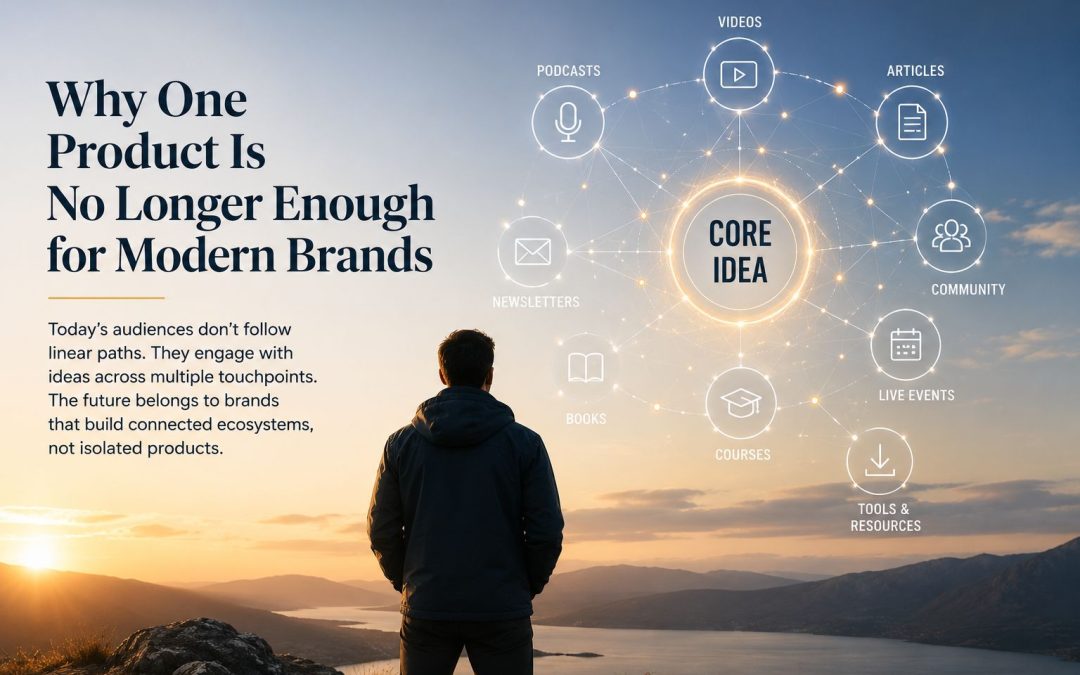
Modern audiences move differently. People rarely engage with brands through one channel alone. They discover ideas through short-form content, podcasts, search, newsletters, YouTube clips, online communities, and recommendations spread across multiple platforms. A single touchpoint might create awareness, but long-term trust usually develops through repeated interaction across an interconnected experience.
This shift is changing how modern brands grow. Increasingly, the strongest creators, educators, and businesses are not relying on isolated products. They are building connected ecosystems around a central idea, where each platform, resource, and experience reinforces the others.
In our article on ecosystem brand strategy, we explored how ecosystem brands turn ideas into movements through layered content, learning environments, and connected audience experiences. This article focuses on a more specific question: why the one-product model is becoming less effective in today’s digital environment, and what modern brands are doing differently instead.
The Single-Product Era Is Losing Momentum
Audiences No Longer Interact in Straight Lines
Audience behaviour used to be relatively predictable. Someone might discover a creator through a book, attend an event, purchase a product, and then move on. The relationship was largely transactional and often centred around one primary offering.
Today, attention behaves more like a network than a funnel.
Someone might first encounter a brand through a short clip on social media. Weeks later, they hear the creator interviewed on a podcast. Eventually they subscribe to a newsletter, download a resource, join a community, or purchase a course. Each interaction builds familiarity, but rarely in a linear sequence.
This matters because modern audiences no longer experience brands as isolated products. They experience them as ongoing environments. The more connected and cohesive those environments feel, the more likely people are to remain engaged over time.
Algorithms Reward Consistency and Presence
Digital platforms increasingly reward sustained activity rather than occasional launches. Brands built around one product often experience sharp cycles of attention: a spike during launch, followed by long periods of reduced visibility.
Ecosystem-driven brands operate differently.
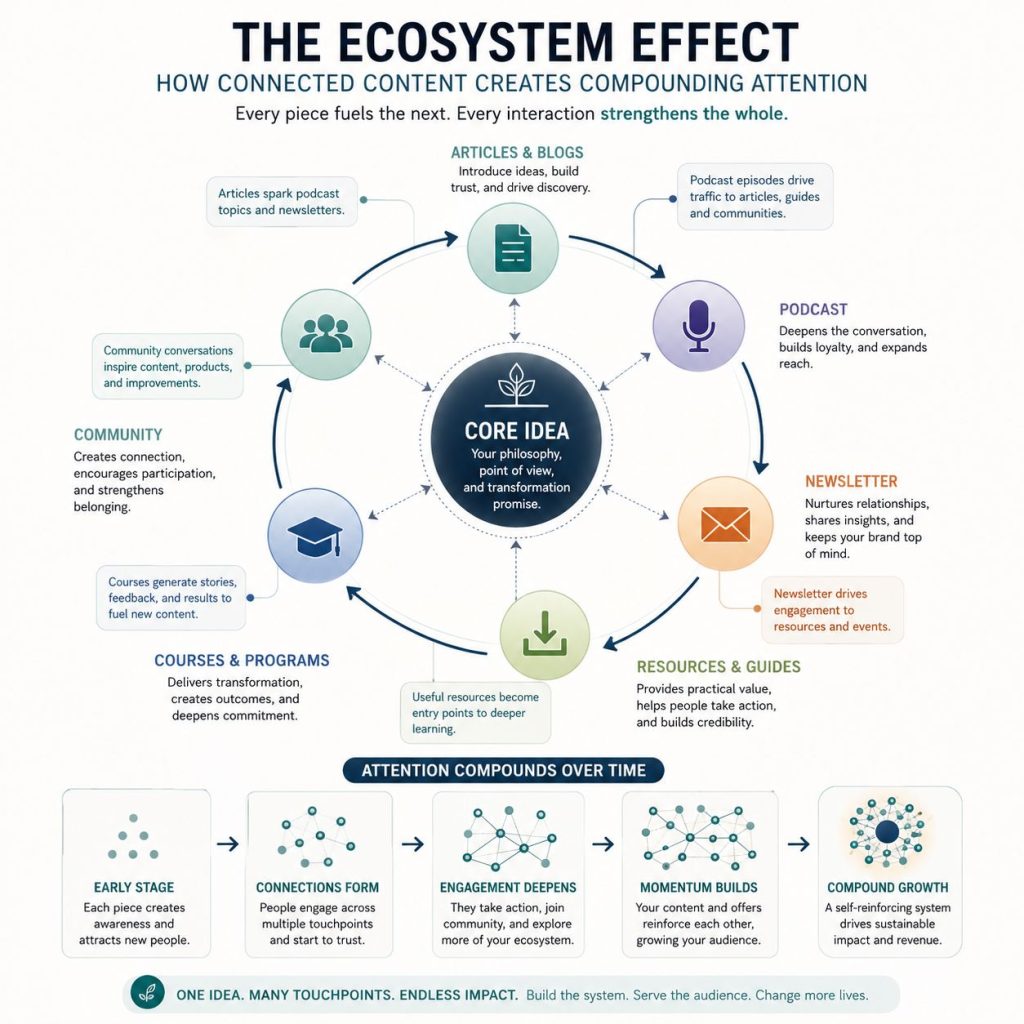
Because content, resources, newsletters, podcasts, workshops, and communities continuously feed into one another, visibility becomes more stable over time. Each asset strengthens the broader system instead of existing independently. A podcast episode supports an article. An article leads to a downloadable guide. A guide introduces people to a larger educational experience.
The result is a brand that stays active in the audience’s world even between launches.
This consistency also creates resilience. Brands relying heavily on one platform or one flagship product are vulnerable to changing algorithms, declining reach, or shifting audience behaviour. Ecosystems distribute attention across multiple touchpoints, making them more durable in unpredictable digital environments.
Information Alone Is No Longer Rare
One of the biggest shifts happening online is that access to information is no longer a competitive advantage on its own. Most industries are saturated with tutorials, advice, courses, podcasts, templates, and AI-generated content.
People are not struggling to find information. They are struggling to find clarity, structure, relevance, and trust.
This is one reason single-product businesses often struggle to maintain long-term differentiation. If the relationship begins and ends with one product, audiences can quickly move on to the next source of information.
Modern ecosystem brands create something more difficult to replace. They provide continuity. They create a consistent worldview across different formats and experiences. The value no longer comes only from the information itself, but from how the audience engages with the ideas over time.
That shift changes the role of the product entirely. Instead of being the final destination, the product becomes one part of a larger relationship between the brand and the audience.
Why Modern Brands Need Connected Experiences
Trust Builds Through Repeated Interaction
Most people do not fully trust a brand after a single interaction.
A person might watch one video, read one article, or buy one product, but trust usually develops gradually through repetition. The more consistently audiences encounter the same philosophy, tone, values, and ideas across different environments, the stronger that relationship becomes.
This is one reason connected ecosystems outperform isolated marketing efforts. Every touchpoint reinforces the larger identity of the brand. A podcast deepens the ideas introduced in a short-form video. A newsletter creates a more personal connection. A workbook or downloadable resource transforms passive interest into active participation.
Over time, audiences stop viewing these interactions as separate experiences. They begin seeing them as different parts of the same world.
That familiarity matters because modern audiences are overwhelmed with content competing for attention. Trust increasingly comes from coherence rather than volume. Brands that feel fragmented or inconsistent often struggle to maintain long-term engagement, even when the individual products themselves are strong.
Connected experiences create continuity, and continuity builds credibility.
Different People Enter Through Different Doors
One of the biggest misconceptions in traditional marketing is the idea that every customer follows the same journey.
In reality, modern audiences enter ecosystems from completely different directions.
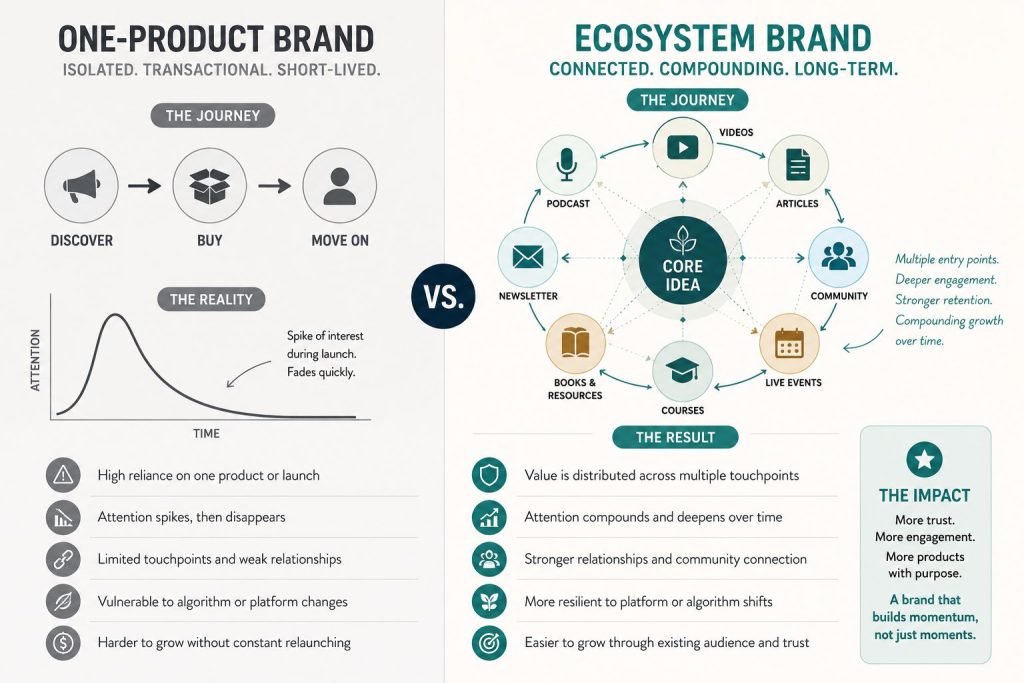
Some people discover a brand through search. Others through YouTube recommendations, podcasts, LinkedIn posts, social clips, books, live events, referrals, or online communities. Many people consume content silently for months before ever purchasing anything.
This is why ecosystems have become so powerful. They allow audiences to enter naturally at different points while still guiding them toward a cohesive experience.
A well-designed ecosystem does not depend on one perfect entry path. Instead, it creates multiple access points connected by a shared narrative and philosophy. Someone who reads an article should feel the same underlying identity when they later encounter the podcast, newsletter, course, or workshop.
This flexibility makes modern brands far more adaptable than traditional one-product businesses. Rather than forcing audiences through a rigid funnel, ecosystems allow people to engage at their own pace and depth.
The strongest brands today are often the easiest to move through.
Ecosystems Extend the Lifespan of Ideas
Most standalone products have a relatively short attention cycle.
A launch generates interest, conversations peak, and then attention gradually fades as audiences move on to the next release, trend, or creator. Brands built around isolated products often find themselves trapped in a constant cycle of rebuilding visibility from scratch.
Connected ecosystems work differently because ideas continue evolving across formats over time.
A single concept introduced in a book might later become a podcast discussion, a workshop framework, a downloadable guide, a community conversation, or a structured learning experience. Instead of disappearing after launch, the idea keeps resurfacing in new contexts that reinforce one another.
This creates a compounding effect.
Older content continues feeding newer content. Existing audiences continue discovering deeper layers of the ecosystem. New audiences encounter ideas that already feel established and supported by a broader body of work.
In this model, products stop functioning as isolated endpoints. They become interconnected parts of a much larger narrative system.
That shift changes how brands grow. Instead of constantly chasing attention, ecosystems create environments where attention can accumulate over time.
The Shift From Products to Environments
Modern Brands Are Becoming Navigational Spaces
The internet has created an overwhelming amount of content, products, and information. Almost every industry now competes in an environment of constant noise, endless recommendations, and fragmented attention.
As a result, people are no longer only looking for products. Increasingly, they are looking for guidance.
This is one reason modern brands are evolving into something much larger than transactional businesses. The strongest ecosystems function more like navigational spaces that help audiences move through ideas, challenges, aspirations, and personal transformation over time.
A fitness brand is no longer simply selling a workout program. A business creator is no longer just selling a course. A wellness platform is no longer only offering information. The audience expects a broader experience that includes learning, reinforcement, structure, tools, community, reflection, and ongoing support.
In many ways, ecosystems reduce friction in an increasingly chaotic digital world. They help people understand where to begin, what to explore next, and how different ideas connect together.
This creates a very different relationship between the audience and the brand. Instead of appearing only during a sales cycle, the brand becomes part of a person’s routines, thinking, learning habits, or decision-making process.
That is a significant shift. Products solve isolated problems. Environments support ongoing journeys.
Community and Participation Matter More Than Consumption
One of the clearest changes happening online is the movement away from passive consumption toward active participation.
For years, digital audiences mainly consumed content: reading articles, watching videos, listening to podcasts, or purchasing courses. While those formats still matter, many people now want more involvement in the experience itself.
They want discussion, interaction, reflection, accountability, and shared identity.
This is why communities, memberships, guided learning systems, live workshops, interactive resources, and collaborative spaces have become such important parts of modern ecosystem brands. Participation creates emotional investment in ways passive consumption often cannot.
When audiences actively engage with an ecosystem, the relationship deepens. The ideas become more memorable because people are applying them rather than simply observing them.
This is especially important in areas like education, self-development, creativity, business, productivity, wellness, and personal transformation. Information alone rarely changes behaviour. Repeated interaction often does.
Strong ecosystems understand this difference. They are designed not only to deliver information, but to create experiences people can move through.
The Brand Becomes the Experience Itself
Traditional brands often treated products as the primary value being offered. The surrounding marketing simply existed to attract attention to the product.
Modern ecosystems reverse that dynamic.
Increasingly, the experience surrounding the product becomes just as important as the product itself. The tone of communication, the structure of the learning journey, the design of the resources, the feeling of the community, and the consistency of the messaging all shape how audiences perceive the brand.
People remember environments that feel intentional.
This is why some creator ecosystems feel far more influential than their individual products alone would suggest. The audience is not simply buying a course, reading a book, or watching a podcast. They are entering a coherent world with a recognisable philosophy, language, and emotional tone.
That sense of cohesion creates something many modern brands struggle to achieve: meaningful long-term attention.
As explored in the broader ecosystem brand strategy guide, ecosystems become powerful when every layer supports the larger experience. The goal is no longer simply to sell products. It is to create an environment people genuinely want to return to.
The Risks of Staying a One-Product Brand
Platform Dependency Creates Fragility
One of the biggest risks facing modern brands is dependence on a single source of attention.
A creator might rely heavily on one social platform. A business may depend on one bestselling product. An educator could build their entire audience around one course launch cycle. While this can work temporarily, it creates a fragile foundation for long-term growth.
Digital platforms change constantly. Algorithms shift. Organic reach declines. Audience behaviour evolves. Trends move quickly. Brands built around one primary channel often experience sudden instability when those conditions change.
This is why ecosystem-driven brands tend to be more resilient. Instead of relying on one platform or product to sustain visibility, attention is distributed across multiple connected touchpoints.
If social reach drops, the newsletter still exists. If a product launch slows, the podcast continues building trust. If one platform becomes saturated, audiences can still engage through articles, workshops, communities, or educational resources elsewhere in the ecosystem.
This diversification is not simply a marketing strategy. It is a stability strategy.
Modern ecosystems reduce the risk of having an entire brand tied to one algorithm, one platform, or one moment of visibility.
Audience Attention Fades Faster Than It Used To
The internet moves quickly. Even highly successful products often have much shorter attention cycles than they once did.
A book launch may dominate conversations for a few weeks before disappearing from public attention. A viral video creates temporary momentum, but audiences rapidly move on to the next trend. A course launch may perform well initially, only for engagement to fade between promotional cycles.
Single-product brands often spend enormous energy repeatedly trying to recreate attention from scratch.
This creates an exhausting pattern where growth depends on constant launches, constant promotion, or constant visibility spikes. The brand becomes trapped in a cycle of chasing momentum rather than building durable engagement.
Connected ecosystems behave differently because attention accumulates over time instead of constantly resetting.
Older content continues generating discovery. Existing resources support newer ones. Audiences have multiple ways to remain engaged between launches. Rather than disappearing after the initial interaction, the ecosystem keeps the relationship active through ongoing touchpoints and experiences.
This creates more stability for both the audience and the brand itself.
Expansion Becomes Difficult Without a Core Narrative
Many brands eventually reach a point where they want to expand beyond their original offering. The challenge is that expansion often feels disconnected when there is no larger narrative holding everything together.
A creator launches a course unrelated to their original audience. A business adds products that feel disconnected from its identity. A personal brand experiments with multiple directions without a clear thematic centre.
The result is often confusion rather than growth.
Without a strong underlying philosophy, new products can feel opportunistic instead of intentional. Audiences struggle to understand what the brand actually represents beyond selling individual offerings.
This is one of the key differences between product-driven businesses and ecosystem brands.
Ecosystems expand more naturally because they are built around a central idea rather than a single isolated product. New formats, resources, and experiences already have context because they belong within a larger narrative structure.
That narrative becomes the connective tissue of the ecosystem.
As explored more deeply in the broader ecosystem brand strategy article, the strongest modern brands are rarely defined by one product alone. They are defined by a consistent worldview audiences can recognise across every platform, experience, and interaction.
What Strong Ecosystem Brands Do Differently
They Build Around a Central Idea
Strong ecosystem brands rarely begin with a product. They begin with a perspective.
At the centre of most successful ecosystems is a clear philosophy that shapes everything around it. That philosophy might focus on reinvention, creativity, behavioural change, entrepreneurship, wellness, productivity, intentional living, education, or personal transformation. The formats may vary, but the underlying idea remains consistent.
This is what gives ecosystems cohesion.
Without a central idea, expansion often creates fragmentation. New products feel disconnected. Content becomes inconsistent. The audience struggles to understand what the brand truly stands for beyond individual offerings.
Strong ecosystems avoid this by treating products as expressions of a larger worldview rather than isolated commercial assets.
A podcast becomes another way to explore the same philosophy. A workbook reinforces the same transformation. A community discussion deepens the same conversation already introduced through articles, videos, or courses.
The ecosystem grows outward while remaining connected inward.
This is one of the core differences explored in the broader ecosystem brand strategy guide. Strong ecosystem brands expand horizontally across formats while maintaining a clear thematic centre.
Every Asset Supports the Others
Traditional marketing often treats content and products as separate activities.
An article exists independently. A podcast promotes itself. A course launch operates in isolation. Social media becomes disconnected from the deeper learning experience. The audience moves between disconnected touchpoints that do not meaningfully reinforce one another.
Strong ecosystems work differently because every layer contributes to the larger system.
An article might introduce a concept that becomes more personal in a podcast conversation. The podcast may guide listeners toward a workshop or downloadable resource. A newsletter deepens engagement between releases. Community discussions generate feedback that shapes future content and products.
Nothing exists entirely on its own.
This interconnected structure creates what many ecosystem brands rely on most: compounding attention. Instead of constantly rebuilding audience interest from zero, each asset continues supporting discovery and engagement long after publication.
Over time, the ecosystem becomes increasingly efficient because older resources keep strengthening newer ones.
This is one reason ecosystem brands often feel much larger than the size of their audience alone would suggest. The depth of connection between the assets creates momentum that isolated products rarely achieve.
They Create Long-Term Audience Relationships
Many traditional businesses focus primarily on transactions. The goal is to generate a sale, complete the interaction, and move the customer through the pipeline as efficiently as possible.
Ecosystem brands operate with a different mindset.
The strongest ecosystems are designed around long-term relationships rather than short-term conversions. The audience is not simply purchasing a product. They are gradually becoming part of a larger experience built around shared ideas, values, and transformation.
This changes how the brand communicates.
Instead of only appearing during promotional periods, the ecosystem remains present through ongoing content, educational resources, conversations, community experiences, and structured learning environments. The relationship continues even when no immediate transaction is taking place.
That continuity creates familiarity, and familiarity creates trust.
It also creates emotional durability. Audiences are more likely to remain connected to brands that consistently provide value across different stages of their personal or professional journey.
This is why many modern creator ecosystems feel more like movements than businesses. Over time, the audience no longer engages with a single product. They engage with an evolving environment that continues supporting them through different contexts and experiences.
The strongest ecosystem brands understand that long-term attention is rarely built through isolated campaigns. It is built through repeated, meaningful interaction over time.
Smaller Brands Can Benefit Too
One of the biggest misconceptions around ecosystem brands is that they only work for major creators, large companies, or businesses with massive audiences.
In reality, smaller brands often have an advantage.
Large ecosystems can sometimes become diluted, overly automated, or disconnected from the audience they originally served. Smaller brands, on the other hand, are often able to create deeper relationships because the experience feels more focused, personal, and intentional.
A creator with a small but highly engaged newsletter audience may have more influence than a much larger account with weak audience connection. A niche educational platform with strong community interaction can outperform a broader brand producing generic content at scale.
This is because ecosystem thinking is not primarily about size. It is about coherence.
A small ecosystem can still create enormous value when the audience clearly understands:
- what the brand stands for,
- how the different resources connect together,
- what kind of transformation or perspective the ecosystem supports,
- and why the experience feels distinct from everything else online.
Even a relatively simple ecosystem can create momentum.
A well-structured combination of articles, a newsletter, a podcast, downloadable resources, and a small learning community may already provide more long-term value than a standalone product operating in isolation.
The key is intentional connection between the pieces.
Smaller brands are also often more agile. They can adapt faster, communicate more personally, and experiment with new formats without the complexity larger organisations face. This flexibility allows niche ecosystems to evolve naturally alongside their audience rather than feeling heavily manufactured.
In many ways, the future may favour smaller, more focused ecosystems over large but fragmented brands.
As audiences become increasingly selective about where they spend attention, depth of connection is becoming more valuable than sheer visibility.
Conclusion — The Future Belongs to Connected Brands
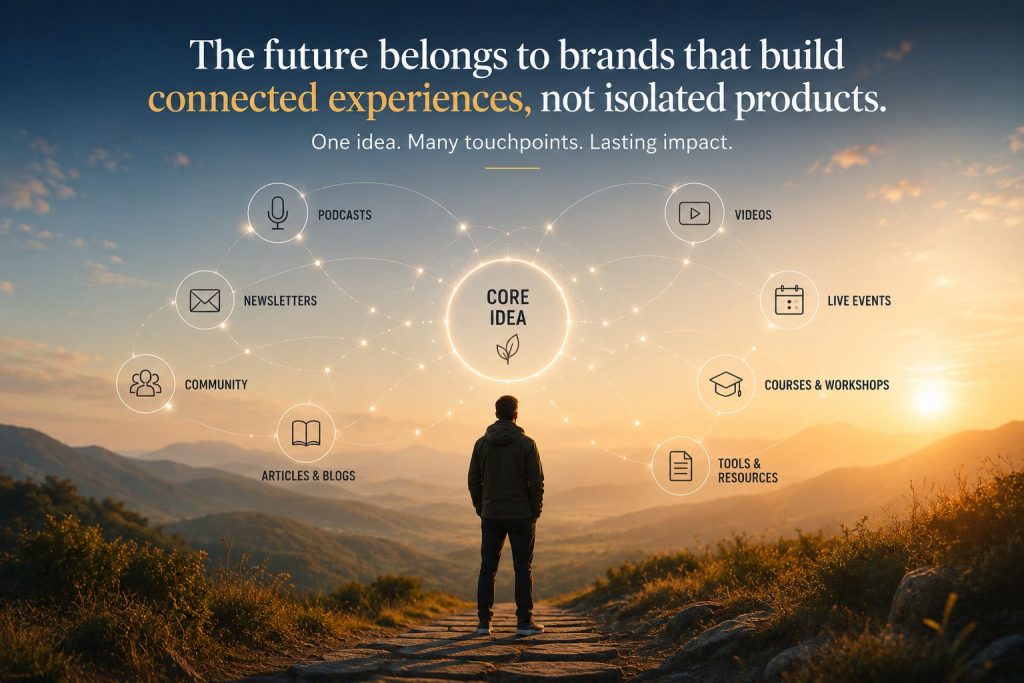
The era of the standalone product is not completely over, but it is becoming far less effective as a long-term growth strategy.
Modern audiences no longer interact with brands in isolated moments. They move through networks of content, conversations, learning experiences, communities, and platforms that shape how trust develops over time. Increasingly, people are looking for continuity rather than one-time transactions.
This is why ecosystem thinking is becoming such an important shift for creators, educators, businesses, and modern brands.
The strongest brands today are not simply producing more content or launching more products. They are creating connected environments that people can return to repeatedly. Environments that feel coherent, useful, human, and aligned around a clear central philosophy.
That does not require celebrity-level reach or massive infrastructure. Even smaller brands can build meaningful ecosystems when the experience feels intentional and connected.
As explored throughout this article and in the broader ecosystem brand strategy guide, the future increasingly belongs to brands capable of creating depth rather than noise.
The question for modern businesses is no longer simply, “What product are we selling?”
A far more important question is emerging instead:
“What kind of experience are we building around this idea?”